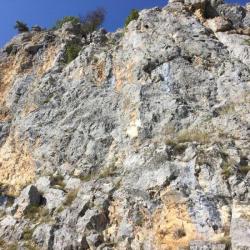
The Villalago crag rises just above the small village from which it takes its name, in the spectacular Sagittario Gorges.
As of today (2026), all the routes have been bolted by Mario Bultrini, starting in 2020.
The climbs are divided into two sectors and are generally quite long: including the second pitches, some lines reach up to 40 metres in length, making the use of an 80 m rope advisable.
The rock is compact, high-quality limestone, solid and well featured on almost all routes. The climbing is varied and complete: the walls offer technical slabs, vertical faces, overhanging sections, corners and arêtes. On these structures you will find routes with generous pockets as well as more delicate lines on vertical crimps and sloping holds.
Grades are generally in the low to mid range, but the technical challenge is consistent: even the easier routes require precise footwork and good route reading.
The approach is short and convenient, and the base of the crag is spacious and relatively comfortable, making the area suitable also for families with children.
The walls stand at approximately 1000 metres above sea level, with exposures ranging from south to south-east and south-west. The crag is therefore ideal in spring and autumn. In winter, climbing is pleasant on sunny days, even with snow on the ground; without sun, however, temperatures can be quite cold.
Climbing here takes place in a landscape of remarkable beauty: below the wall lies the Sagittario Valley, while above rise the wooded slopes of Monte Genzana. The silence, the view of the peaks of Montagna Grande — snow-covered in winter — and the wide breath of the gorges make the experience particularly evocative.
The Village
A short distance from the crag lies Villalago, listed among Italy’s Most Beautiful Villages. Perched on a rocky spur overlooking the Sagittario Gorges, it preserves a compact medieval layout, with narrow alleys, stone arches and tightly clustered houses facing a rugged yet luminous landscape.
The village is located in one of the most unspoilt natural areas of the central Apennines, characterised by limestone cliffs, deep canyons and high-altitude plateaus, home to wolves, deer and golden eagles.